Showing posts with label poetry. Show all posts

1.9.11

Staying Power.

It was another poetry meeting tonight, and I think I managed to hold my own. Today's poem is inspired partially by my last blog post, actually: "Words That Stay" is still resonating with me, and encouraged me to try getting a bit fancier in my philosophizing about paper. I really like "rubber scars" when talking about eraser marks, even if the phrase "don't hide any lies" is a bit clunky.

But hey - if I can like two words in an eighteen-line poem, I'm probably doing better than most poets. : )

A split down the spine and two volumes are born
multiplication from division
another clean canvas with every leaf torn
previous chapters are forgiven
pore over the pages left scattered behind
evidence of an early edition
the scars of rubber don't hide any lies
subtraction now becomes addition

The threatening cast of a permanent record
clouds over confidence and heightens the risk
feed its existence into a shredder
end its reality, set it adrift
at the cellular level a problem is found
the grain is a network of splinters and chips
the might of a forest, internally bound
shredders will choke, they will jam, they will spit.

It's a curse and a blessing for novels and plays:
The essence of writing is words that will stay.

4.8.11

The Krebs Cycle.

I'm happy to say poetry night was a success! Sapo was an amazing act -- almost like some forgotten strain of vaudeville that had evolved in a forest after a hundred years away from outside influences. It was a strange and wonderful honour for our humble poetry group to open for them.

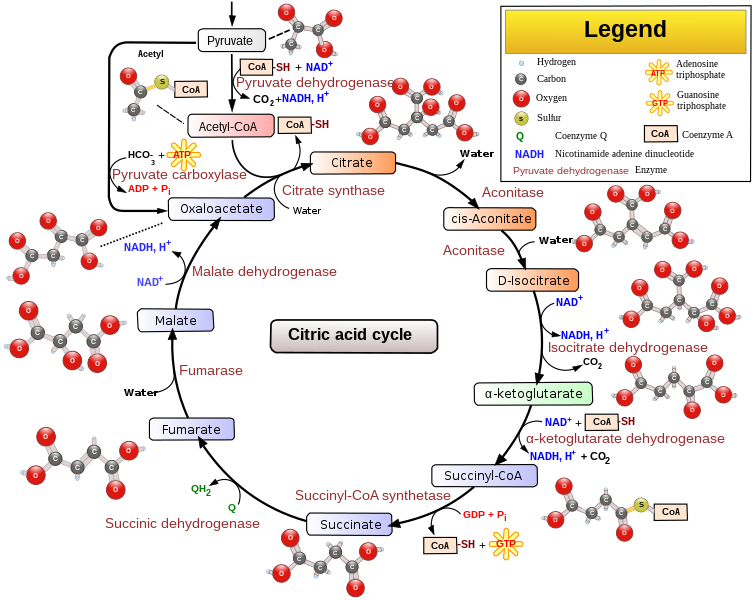
As for my poem, I'm quite happy with it, since it was the culmination of a challenge I'd given myself months ago: Write a poem about the Krebs Cycle.

What a beauty, eh?

Simply put, the Krebs cycle is how the body breaks down glucose to produce energy. It's a vital process, and it manages to be wonderfully efficient and adaptive - in its own special way. The problem is, it's also incredibly confusing, and ill-suited for poetry. But never let it be said I shied away from the challenge!

To make up for the cheesy meter and rhyme scheme, I'll let you know of a few curiosities in the text.

  • Most importantly, almost every stage in the cycle is represented by one verse. Each verse has a number of lines equal to the number of carbon atoms involved in that stage. (Glucose breaks down into two three-carbon pyruvate molecules, which is why that verse is repeated.)
  • The Krebs Cycle has an anaerobic portion and an aerobic portion. If the body doesn't have time to breathe, it relies solely on the less efficient anaerobic portion. The aerobic portion of the poem is bracketed by the words, "Breathe."
  • "Under strain ... drawn and quartered" (Verse 3) refers to the third carbon atom in citrate, which has quaternary substitution, a formation that is very challenging to work with in the laboratory. (Warning: link is TOO safe for work.) It would surprise nary a single chemist that the first thing the Krebs Cycle does with citrate is convert it to isocitrate, which has only a tertiary substituted carbon.
  • "double braced and inflexible" (Verse 7) refers to fumarate, the only molecule here with a double bond - and they are indeed inflexible. If a molecule of water is added to those carbons, it becomes a single bond which can rotate freely. (Verse 8, line 3)
  • The line about the alpha male refers α-ketoglutarate, because I can't find a rhyme for α-ketoglutarate.
  • I can, however, find partial rhymes for "Succinyl CoA" and "Succinate", and I mention an ox and ass eating at the end to represent "oxaloacetate". Good enough, says I.
And so forth. The only other observation I'd like to make is that much to my surprise, a cell's production of energy is (metaphorically) rather similar to a society's production of buildings. Does this mean buildings have to be "spent"? Or are they spent, in a way that doesn't require their destruction? An interesting question to ponder some other day.

But for now... here's the poem!

THE KREBS CYCLE

by Denton Froese

(1) There's not enough time
There's too much demand
The matters at hand are pushing the line

There's not enough time
There's too much demand
The matters at hand are pushing the line

Breathe.

(2) These problems have been solved before
listen to the future's needs
cycles rise upon the shore
and fall into the endless seas
accept the aid and join the core
of vast and mighty entities.

(3) It's hard to perceive the view from a corner
links aren't visible, only the chain
stability comes with a bit of reorder
to help and to be helped requires a change
twisted in knots, drawn and then quartered
shift under the weight, relieving the strain

(4) Amputation brings extension
the alpha male sends out its pack
bid farewell to what you treasured
the bridge is stronger, mind the gap
emptiness brings satiation

(5) The divine will go pray to rejoin the flocks
the towers rise, the city spreads
the trees shall grow with what is lost
from the huddled outward breath.

(6) With all this time in flux, the wait
pays off for those trapped in the mass
the old designs regenerate
and shout against the stagnant past

(7) Built for strength, a mighty fortress
doubly braced to waves and winds
inflexible in times of stress
or when smoke curls from within

(8) Submerge, dissolve, expand, forget
dance to the music of orbital spheres
turn freely and don't be afraid to get wet
take in the view as the ending draws near

(9) The ox pulls the yoke, encircling the field
back to the spot where the first seeds were sown
the ass eats some grain from the previous yield
and then back to work for the next journey home.

Breathe.
And there you have it! I hope you liked at least some part of this little bit of singsong doggerel... and who knows? Maybe now that I've gotten this out of my system, my next poem will feature some sort of emotion!

It will be my greatest challenge yet.

(p.s. The line "amputation brings extension" is actually taken from one of Marshall McLuhan's books. Apparently, I felt this poem wasn't academic enough.)

7.3.11

Poetry Pants.

I already mentioned the success of the poetry night last night, but I never posted any pictures. Fortunately, there was a talented soul with a camera out there willing to help. (Wow. I look so natural and relaxed, when I'm not holding the camera with one hand, or running into position before the auto-timer goes off.)

Photobucket

Not bad, eh? I especially like how he managed to catch me at "maximum pretentiousness."

6.3.11

Request For Comments.

So, after the serendipitous night of poetry, I figured that maybe I might be able to keep up this little charade. So I'm now signed up to read at the folk music society's singer-songwriter night on the 18th of March.

I'm sure they'll be appreciative, if only because that'll be ten minutes that the audience will have something to see besides some guy tuning his guitar. But I certainly don't think that now's the time to be coasting on the success of one villanelle.

So, I'm going to need a new topic. I've done Indiana Jones, Star Wars, and le*pards.

What should I write about next?

2.3.11

Benediction.

I just got back from the poetry evening - what an amazing event! We had crazy wordflow slams, heartfelt love poems, dark brooding questions about faith, fairy tale epics, lyrical accusations for a drunken ex-boyfriend, some Shel Silverstein, a bit of improv... and a guy in weird-looking pants talking about Indiana Jones and leopards.

I've already talked enough about my poetry on this blog, so instead I'll take this space to marvel at the talent of a hundred different rivers that flowed together tonight. I had no idea we'd draw such a wonderful crowd.

Some people, though, were counting on exactly that. Specifically, one person who was (unbeknownst to me) doing a bit of scouting for a play she's producing (Although, to be fair, most producers I've known are *always* in a state of constant scouting). After my set, she came up and said, "How come you're not in my play?"

At first, I was a bit defensive. I say a lot of things to a lot of people, and they often start with, "You know what we should do some day?". I wasn't entirely sure I hadn't already signed up somehow without knowing it.

But finally, we got our stories straightened out, and it seems that she's looking for someone to play Benedick in her summer production of Much Ado About Nothing.

That's right - Medicine Hat's Inaugural Shakespeare in the Park Festival, June 2011. Starring me. (Perhaps. I mean, they have understudies for a reason.)

And now, if you'll excuse me, I think I have a play I'd better read.

28.2.11

It works for Etrigan.

Argh! Ever since I got all fancy with the font options for that Young Galaxy post, I can't shake the feeling that I messed up the default settings. Then again, I suppose there's a difference between "minimalist aesthetics" (what I wanted), "simple and clean" (what I'd settle for), and "default settings" (what I got). Maybe I should take this as a sign to start fiddling... but maybe later.

Anyway, the poetry night is Wednesday, so I've been busy preparing for that. Over the weekend, I tried my hand at edgy social commentary in the form of free verse: I already know that slam poetry's awesome, and I still want to work my way towards that. So, I went with an experience I once had in Ottawa: an unemployed man approached me on the street and asked me for ten dollars. That was a bit more than the price of cheap calories, so I asked him why... he explained that he had a job lined up in Fort McMurray, but he just needed to get there, and he had to supply his own steel-toed boots.

Now, I've never been to Fort McMurray, but even in Swan Hills they'll pay for your steel-toed shoes as a job perk. They even paid for *my* steel-toed shoes, and I never dropped anything heavier than a ball-point pen on them.

(Well, that and sixteen litres of hexane. But that's a different story.)

So was this fellow lying? Was he hoping that the appearance of self-betterment would help his panhandling? Did he figure that getting ten dollars an eighth as often as getting one dollar would be more profitable in the long run? I can't really argue the cynics in that appraisal of the situation.

But yet... what if he simply had his story wrong? What if he heard from a friend of a friend of a friend about the good life in the Oil Sands, and along the way, the stories got distorted so that the steel-toed boots became the key that caused those kingdom gates to open, rather than simply being direct consequence of living there?

(And it is, too - I doubt there are schoolteachers or dental assistants in Fort Mac that don't have their own pair of steel-toed footwear.)

If that's the case, then this unemployed fellow is not the swindler, but the swindled. Who knows? Perhaps he's already paid some unscrupulous headhunter a "finder's fee" to line up a job for him... Either way, I thought it was an interesting commentary on the perception of the Oil Sands in Ottawa, so I tried knocking out some blank verse that reflects such a view.

And then I tried editing it a little, and it turned into a terzanelle. Maybe I'm just going to be one of those poets cursed to rhyme in everything they write?

Anyway, here you go.

Strangely efficient, strange that it's necessary
This is the hour they hose down the Glebe
The African restaurant's still open to passersby

Spilled beer and pizza run into the street
His jacket of denim deflects the deluge
This is the hour they hose down the Glebe

He wants to be clear, he's not asking for food
It now seems like everyone's caught in a hurry
His jacket of denim deflects the deluge

He could start work tomorrow in far Fort McMurray
He just needs ten dollars for steel-toed boots
It now seems like everyone's caught in a hurry

He can't ask for quarters, seeking humbler loot
It's a myth told by friends he has to believe
He just needs ten dollars for steel-toed boots

He's convincing himself or the people of Glebe
Strangely efficient, strange that it's necessary
It's a myth told by friends he has to believe
The African restaurant's still open to passersby

It's not quite right - not just yet. As is always the case with these things, the central image that inspired the whole thing (the homeless Caucasian being ignored outside a bustling African restaurant) is also the line that doesn't quite fit anymore. Argh! Ah, well. Such are the demands of the terzanelle.

Anyway, thanks for reading - both the poem, and the blog for its first month of revival! Here's to many more, and many better!

22.2.11

Nothing rhymes with "lead refrigerator".

I could get used to this poetry thing.

Really, the hardest part is figuring out what I want to say. But once I've got that established, it's just a matter of fitting the right words in the right places. It's kind of like Sudoku, except that you can show it to others once you're done.

And much like last time, I've circumvented the first step by delving into fanfiction. Although I'm pretty happy with the end result, since it seems like I might be talking about metaphors for life, when I'm actually just referencing the timeline from Raiders of the Lost Ark.

Not that this is the end result quite yet - I think there are a few synonyms and prepositions I have yet to tweak. But, it's close enough to warrant sharing - so voilà!

For truth and wisdom, ask the earth
The road to glory has a map
In time, all things will rise in worth

Gouge the soil, it does not hurt
The prize it guards, it did not trap
For truth and wisdom, ask the earth

The raven's call will guide your thirst
from dampened ditch to mountain cap
In time, all things will rise in worth

Half the riddle's solved with words
the sun lights the remaining path
For truth and wisdom, ask the earth

Fear not the treasure hunter's curse
Look not at what you have in hand
In time, all things will rise in worth

The journey must go on, but first
the doctor dons his favourite hat
For truth and wisdom, ask the earth
In time, all things will rise in worth.

See what I mean? I'm not talking about following the call of nature to go out and explore and sate your spiritual thirst; I'm talking about finding Marion Ravenwood in the Himalayas during a drinking contest.

"The curse of the treasure hunter" isn't to be discontent with what you've just found, and to always yearn for the next discovery. No, the curse is something that will melt your face off if you look at it.

Still, if anyone ever wants to publish this... well, hopefully they won't have read this blog entry.

Our little secret, okay?

Oh, and here's a little bonus content:

There once was a scholar named Marcus
Who found himself lost in the dark-us.
He cried for a week
In his best Ancient Greek
'Til he found his way out of the park-us.

10.1.09

Also, Stampede Wrestling.

This weekend, I relaxed with an iced coffee inside one of my favourite cafés in Medicine Hat, while reading a translation of Eugene Onegin, Alexander Pushkin's early 19th century epic. One of my friends from work was also there, and after a brief chat, I left her to continue her reading: Doctor Zhivago.

You can say that Medicine Hat is culturally bereft, and in the standard understanding of the term you'd be correct. We're famous for Kalan Porter, not Cole Porter, after all. But somewhere in Paris, underneath some wrought-iron arches, there are two people drinking Slurpees and arguing over whose car is most impressive with the ladies. I feel safe in declaring a victory of some sort here.

It did get me thinking, though. Culture (once again, in the ill-defined standard definition) is not something that can be consumed -- it can only be produced. The only way to increase it around you is to increase it in yourself. And yes, it can exist anywhere. It's just that it's easier to nurture in some places more than others. Still, if your city's not cultural enough, the solution starts with you.

Perhaps the reason I'm dwelling on such matters is that Eugene Onegin is surprisingly delightful, and I've been moved to speak in praise of the Arts. I was especially touched by the last stanza of Chapter One, which portrays the courage of an author willing to let go of his writing:

About its structure I've been brooding --
Its hero, how he'll be yclept;
But meanwhile, look -- I'm just concluding
My novel's Chapter One. I've kept
My eye alert to weak depictions,
And noticed scores of contradictions;
I'll leave them, though, with no regret.
To censorship I'll pay my debt.
I'll hand reviewers, who'll devour,
Fresh-fallen fruits of pen and ink.
Fly bravely now to Neva's brink,
My newborn opus, fly and flower,
And earn me glory's just deserts:
Hot air, vain noise, faint praise that hurts.


And since those last two lines apply equally well to anyone who talks too much about a city's culture, perhaps I'll be quiet and go play some video games now.

11.12.08

The Anti-Novel.

Last week, I attended the book launch for DailyHaiku.org, where I learned quite a bit about what modern haiku actually is. I suppose the first thing to say is that the 5-7-5 structure is no longer applicable -- unsurprisingly, seventeen Japanese syllables are different from seventeen English ones. So, not only did English haikuists get hung up over whether "conceal" was two syllables or three, but on average, Japanese poems were quite a bit shorter as well.

grasses in water
conceal the green shoreline
by surrounding it

Note the clunky adjectives taking up space, the forced pronunciation of "conceal", and the pronoun at the end, rushing to complete the thought. This haiku could be hammered out to be more lyrical, but the point of haiku wasn't to be a word game. Instead, the new rules of haiku have been simplified to follow the spirit of haiku, rather than the letter. Now, it's simply "a descriptive poem no longer than a single breath." More like this:

grasses in water
hide the shore
from itself

That's much more concise than the first one. It says what it needs to say, and the audience is able to picture a moment similar to the author's description. No more than a moment, either -- no more than what someone could experience during a single breath. Contrast it with this:

The gopher rises
The hawk descends
Three of its chicks are missing

Sure, you could say that in one breath, technically, but it's clearly two ideas, which would require quite a bit more observation on the audience's part. Instead, the author breathes out a single moment, the audience breathes it in. It's like CPR for memories.

I also learned about haibun -- that's a form of longer poetry, which consists of a line of prose, often partly based on the author's personal experience, followed by a haiku. Each one conveys an individual thought, but they tell a story together. I liked the idea, so I thought I'd give it a whirl. Hope you enjoy it!

Leaving the hospital, my brother drives. The dashboard lights up his face. We joke about brain injury, and a shard of glass which the doctor missed gets carried upward with my cheek as I smile.

Summer twilight
will not reveal
the end of the road

17.10.08

The wrong turn of Froese.

Today was an interesting day: The Walrus Expedition's Official Log arrived in my inbox this morning. A full report of all the events, along with some interesting commentary. For example, my dancing was described as "Unquestionably Lethal". Now, that by itself is enough to let me die a happy man, but I also had the privilege of seeing a poem I wrote included. I'll let you read it for yourself... and try to find the one small error they made.

Blue towers watched us watching
As we sailed to Radstock Bay
We manned the decks in hopes to see
Our Expedition's name.

A branch, a rock? A shoal, a flock?
'Twas all a distant haze

'Till three large stones the shade of bones
Got up and walked away.

The whisper roared throughout the ship:
"Polar bears in sight!
The barren shores of Devon
house a family in white!"

The mother kept her cubs alive
throughout this slow September,
while all our cameras zoomed and whirred
in order to remember.

My frames were out of focus,
my hands shook like a die,
but the pictures still show who was there;
The polar bears and I.

-Denton Froeme


It's so nice to be published... less nice to have your last name misspelled, though. Ah, well. At least now, I have the unparalleled joy of saying, "That wasn't me! I've been Froemed!"

Really, a pun that awful makes it all worthwhile.

8.10.07

With or without.

This started out as a good weekend. I’d discovered Canada Writes, and decided to submit a two-hundred-word poem into the contest.

There was just one problem: my favourite literary device is logorrhea. Not surprisingly, taking my thoughts and scaling them back to two hundred words was like cutting off my arm with a pencil.

Worse, it's in iambic tetrameter. I spent the entire Sunday morning agonising over two things: whether the word "with" should be in line 3, and what three-syllable, middle-stressed word could describe a cityscape. You know, something like "imposing".

(...wait a second.)

At any rate, this was doubly frustrating for me, because I had just attended a slam poetry festival in Edmonton. Wasn't I inspired by the adrenalised emotion of their unfettered words? Their ability to scream epithets against monkeys whenever they pleased?

No, the sad truth is that although I'd love to don the black leather jacket of modern free verse, my physique doesn't fit anything but the blue employee's vest of happy sing-song. I guess that sometimes suffering for your craft means that the reader can't suffer with you.

Poetry can be so cruel sometimes.

24.9.07

The sun comes up on the flat Edmonton streets.

There's a certain etiquette to lifting lyrics: stealing from The Weakerthans is like sharing a dessert. Stealing from The Tragically Hip is like joining a celebration... but to steal from Leonard Cohen is a sort of blasphemy.

(Stealing from Rheostatics, on the other hand, is like trying to bite through a coconut, i.e., "Just stop already. At first it was funny, but now we're getting embarrassed just watching you.")

That's not to say people don't quote Leonard Cohen, but when they do, they make sure he gets full credit, and pay him the proper respects. The tribute concert on Saturday was no different -- there were five different singers featured, and with each one, you could see their face brighten up when they got to the part of the song with their favourite lyric. It was like watching a child finally escape the fairground lineup and climb up onto the roller coaster.

Better yet was when they messed up one of the lyrics, though -- then, their face pulled back into that horrified laughter you see when the camera catches the roller coaster at the start of a drop. Everybody knows that they're in trouble, but everybody knows what they're going through. After all, who'd want to be in their shoes, misquoting Leonard Cohen when they're trying to honour him?

It was a fantastic concert, though. The singers were captivating, the audience was supportive, the theatre was beautiful, and the arrangements were a fine blend of re-creation and recreation. Add the company of some wonderful friends, and a truly awe-inspiring spoken-word performance the previous night, and you have a perfect weekend for poetry.

The final cadence to the evening came when my friends and I left the theatre. The conversation turned to how often people would initially use Cohen's songs for a love ballad, only to be shocked when they finally realise what his lyrics are really saying. I tried to explain the phenomenon thusly:

"The thing is, even if it's not a song about true and eternal love, it still manages to stir up the same emotional triggers we associate with those emotions. He triggers the same effect through a different cause. It's kind of like when you're overcome with a sense of warmth and serenity... and four seconds later, you realise you've just urinated in your pants."

From the reaction of the couple right next to us, it was apparent that some people have a different idea than myself on what constitutes blasphemy towards Leonard Cohen.

Doesn't change the fact that I was right, though.

17.9.07

International Talk Like A Poet Day.

It's hard not to love Robbie Burns Day. People carouse with fake Scottish accents, and haggis and bagpipes are not only present, they're lauded. People might veer away from such things for most of year, but on January 25, they'll allow themselves the indulgence of something different. I could also argue that people like the indulgence of a little tradition: it's nice to know that there's a day set aside purely for low-tech, old-fashioned merry-making.

Wouldn't it be great if there was a day like that for Canada's most famous poet, as well?

There's a problem with that, though -- for most good-hearted people, the idea of discussing Canadian poetry is far more unappealing than bagpipes and haggis. Chances are, they won't stick around long enough to ask, "Which poet?"

That's too bad for them, because the answer is Leonard Cohen.

Some brave souls reached that conclusion a few years ago, and ever since then, Leonard Cohen Night has been gaining popularity. In Edmonton, there's going to be an art exhibit, an open mike for any and all poets, and finally, an evening concert where local artists sing his songs.

This is probably where some people would ask, "So, if it's like a Canadian Celebration, does that mean we can get plastered there?"

Sadly enough, they've got a point. Robbie Burns Day is a whooping, roaring party. Leonard Cohen Night is a dry grad in comparison. Will it ever be popular enough to really take off? Because I'm an eternal optimist, I wager it will, and here's why...

Behold, ladies and gentlemen, the only time I shall ever post a photo from the Emmys on this website. That dapper gentleman right there is none other than Steve Wozniak, Apple co-founder and geek extraordinaire. He looks powerful and confident. He's got his act together. And he's wearing a really nice suit.

I would argue that Woz there doesn't look this good in a T-shirt.


...Nope.

That's the magic thing about Leonard Cohen: He's an incredible poet, true. He's a national treasure, undoubtedly. But he's also able to put together style and class, truth and beauty, the public and the private... and he can hold all those things in that critical balance which gives him a grace unequalled. It's the crowning achievement of a poet, to be as noble as a lord yet as wise as a monk. He always bears himself like he's wearing that suit, and he can bring you to that same special level.

That grace is a rare thing in this world, and it's something that deserves celebrating.

So, even if there aren't any Leonard Cohen festivities in your town this Friday night, throw one of his recordings onto the CD player, open a bottle of wine with some friends, and raise a toast to the man who teaches us not to fear our own potential.

One might even say he sees our perfect bodies with his mind.