Burger week. A seven-day celebration in Halifax where over 100 restaurants create a feature hamburger for the public. It's a fun time, but how does one choose where to start? How does one know when to stop?
I figured that since there are seven days in burger week, I'd get seven friends to choose their champion. Specifically, I asked them, "Which burger should I eat?". This didn't always mean they would pick the best burger -- sometimes there are other motivations driving their recommendations.
To make things more interesting, I asked seven friends in Western Canada, with limited knowledge of the reputations of local restaurants. I got eight replies, but that's okay. I was up for the challenge.
And now, it was time to try them all, and decide which one was the best.
THE VETTING
Four stars? 11/14? 92%? Instead of the standard grades, I'm trying a different method of judging: I'm going to compare each burger to a post-apocalyptic warrior of the barren wastelands, based on the qualities of the burger. Then, those characters will be ranked according to fighting skill and general likelihood of survival.
THE THANKING
I honestly did enjoy every one of these burgers. They were all put out by restaurants trying hard to impress, they were all tasty, I had a lot of fun putting this all together, and it was a comforting thought to know that each of these burgers held a connection to a friend of mine.
I thank all eight of my friends for their suggestions. No one chose poorly.
THE RANKING!
8. 3sixty’s "Original Sin" (chosen by J.H.)
6-oz burger, topped with blue cheese, arugula, tomato jam, pickled apple, smoked bacon and avocado dressing, on a sundried tomato brioche bun with fries.

One of my first thoughts when I read this description was, "Tomato jam? How is that different from ketchup?". Much to my surprise, it was exactly as advertised: tomatoes stewed in sugar and pectin. It was as sweet as any other jam you'd spread on your toast at breakfast. The pickled apples were also very sweet.
The smoked bacon was very thin and crispy. Normally that's not how I prefer it, but it was a good decision here to provide a bit of crunch. Besides, it was also the pinkest patty of the the eight I tested, so the bacon provided a necessary counterpoint.

Alas, there wasn't a lot of synergy between the sweet and the meat. The blue cheese had a very strong aroma, and the arugula was falling out of the burger with abundance, but neither of those elements blended with the rest of the burger, either.
In the Burgerdome:
Original Sin? It's not that easy... the conflicts within this burger betray its heart. This burger is the disillusioned priest, still struggling to deal with a world that has abandoned him. He did everything that was asked of him, he helped people and offered guidance and support. He never asked for anything above his station, and he was content with his life. And now the world has fallen. Is this punishment? Is this a test? Devastation this complete, this vast, has to be a divine message. So why can't he understand what that message is? This failure tortures him. He still offers advice, and words of comfort. He protects his people, even though that's required him to do unforgivable things. But he can not lead them. Not yet.
7. Ace’s "Jughead" (chosen by M.B.)
Smashed NS beef, strip bacon and American cheese.
 According to the menu, the grill closes at 22h00, but they keep making the Jughead until midnight. It's designed to be the most reliable burger in the kitchen. A basic, no-frills production.
How is it? The first smell reminded me... of A&W. And that’s a good thing! I’m not too proud to walk away from a value menu. Fast food companies put a lot of work into making their burgers smell good, and these guys got here naturally.
It tasted like a fast food bacon cheeseburger, too, just with more meat and more bacon. Nothing wrong with that, right?
In the Burgerdome:
A burger this simple, this self-reliant, is the scavenger of the wastes. "Rule Number One: Never get involved." Don't waste time bartering, or being suspicious of whether you can trust others. Just don't trust anyone else, and you'll never be betrayed.
Hide all day. Wake up at sunset and go looking for what you need. Take what you find. Eat what you kill. Don't make a name for yourself, don't leave any victims behind to become enemies. Just live for another day, and you'll be better off than most of humanity.
And yes, he wears his hat at a jaunty angle. He just likes it that way.
6. Durty Nelly’s "Gaelic Steak burger" (chosen by B.G.)
NS beef patty, double-smoked bacon, Jameson whiskey peppercorn sauce, sauteed onions and mushrooms, shoestring potatoes, horseradish, grainy mustard and aioli, served on a sesame seed bun with hand-cut fries.
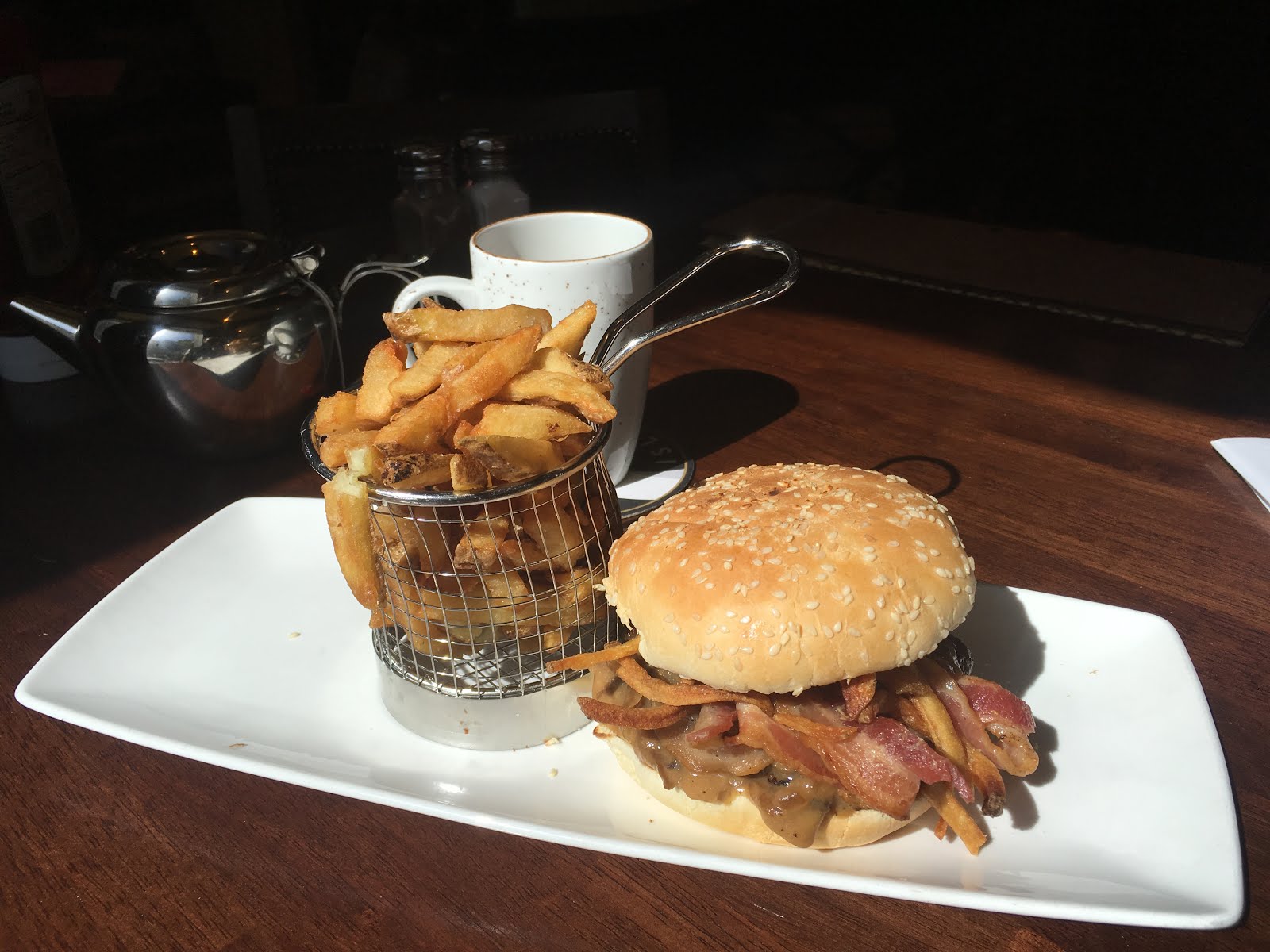
The aroma here is of a well-marinated steak with mushrooms. Lovely. The shoestring potatoes in the burger add a nice crunch with every bite, and they almost create conduits for the liquids. After a single bite, the sauce is already running down my fingers.
There's a very strong mushroom presence throughout. Bacon only registers in the chewy aftertaste. It's strange that the bacon isn't more noticeable, but it's stranger still that I don't really have any impression of the patty itself. Are the mushrooms too strong? That seems unlikely, since I love mushroom burgers, but other explanations elude me.
The mustard was top-quality, and I wish there'd been a little more. The sauce is nice and peppery, and the garlic mayonnaise tastes great on the bun... but there it is again. Why can't I taste the mayonnaise on the meat instead?
I do love mushrooms, though.
In the Burgerdome:
The mushrooms and runny sauce are easy clues: this burger is from the Underworld. The towns above needs the underworld to provide fungus for food and energy, and medicine, but the clan below makes sure they're the ones in charge of the negotiations, and if they don't like the deal, they disappear into their caverns and your wells dry up.
They've still got their enforcer, though — when she comes out to brave the sun, she's half-drunk and coated in grease. Between her staggering and her slipperiness, she's impossible to hit. She can calmly take out a whole crowd of fighters, one at a time. She takes no pleasure in the sport, though, and she feels no need to kill if she doesn't have to. This is just business.
5. The Split Crow’s "Smoked Up Crow" (chosen by D.G.)
An all-beef burger infused with Halifamous Chris Brothers pepperoni, topped with sauteed mushrooms, bacon, smoked cheddar and smoky garlic mayo.

"Smoke" is the theme of this burger, and they tackled it with commitment. An aroma of smoke and crispy bacon rises from the burger as soon as it arrives.
They pulled off an interesting trick with this burger: when you take a bite, the first thing you taste is the meat, and then the smoky spice starts to fill in the picture. You keep chewing, and then, right as the smoke clears, you taste the meat again... but this time, it's the taste of pepperoni! I was genuinely impressed -- usually when I read "pepperoni infused", I think, "too cheap to add actual pepperoni". Not only that, but a stick of pepperoni inside a burger doesn't sound that appetizing.
But no, they truly delivered a burger that was more than the sum of its ingredients. That sort of cleverness is far beyond what I expected from a $6 special.
The other toppings serve to set up the deceit: they help the initial taste of a good burger, but after that, their work is done and they're barely noticeable. The cheese isn’t really a contributing factor, either, except that it’s a bit chewy.
In the Burgerdome:
The element of surprise serves this warrior well -- he's the badlands ninja, appearing and disappearing at will. Be it a dark alley, a sandstorm, or a smoke bomb, any distraction is all he needs to gain the advantage.
4. Unchained Kitchen's "Smokey Gator Hawg" (chosen by C.C.)
Bayou-raised alligator, Acadian pork belly, fried onion straw, apple relish and gator gravy.

Yes, alligator! I'm glad I got the chance to investigate this...
This burger was served tightly wrapped in foil, and we were instructed to unwrap it, and pour the gator gravy over the burger. Unwrapping the burger unleashed a pungent, steamy mix of grease and herbs.
The herbs were also heavily present in the gravy. I think it was rosemary and sage in particular? It was an excellent choice - both alligator and pork belly are light meats, so the herbs complemented the meat and gravy much better than spices would have.
The burger had an amazing texture. It was chewy but with a yielding crispness, like a toasted marshmallow.
I can't overstate the greasiness of this burger, though. Both types of meat are greasy, and I was wishing for a finger bowl of lemon water by the end of the meal. However, it wasn't the heavy grease of a cheese pizza, it was much lighter than that - the level of fattiness was similar to a slice of pork belly in your ramen, which was fine by me... but that grease also had another, less pleasant resonance in the aftertaste. It was so greasy, I feel like the water I drank didn’t actually contact any food in my throat!
Perhaps that's the reason they suggested pairing the burger with a citrusy cider -- I can see how that would have been a perfect match.
In the Burgerdome:
Exotic light grease that needs backup cider: this burger is an example of an exceptional tool and a rare skill, each one useless without the other. But when combined, it's incredible to behold, the stuff of legends.
She's the sky pirate, the only one in the whole blasted territory who has an autogyro and knows how to fly it. Everyone loves her -- even when she's stealing from a caravan with your supplies on it, you're a little bit excited that you'll have a story to tell. Besides, she's not all that bad. She's saved everyone's life at some point, with her warnings about storms or bandits approaching from the distance, and by the time you're ready to pay her price for transport, your cause is usually dire enough that she'll take pity on you and do it as a favour.
But it's always in the back of her mind... without the gyro, what would she do? Could she survive? The thought haunts her, and keeps her a little bit on her guard, removed from everyone else. But even so, it's probably for the best that she doesn't get too friendly with people. She's a pirate, after all.
3. The Press Gang's "Roo Burger" (chosen by J.G.)

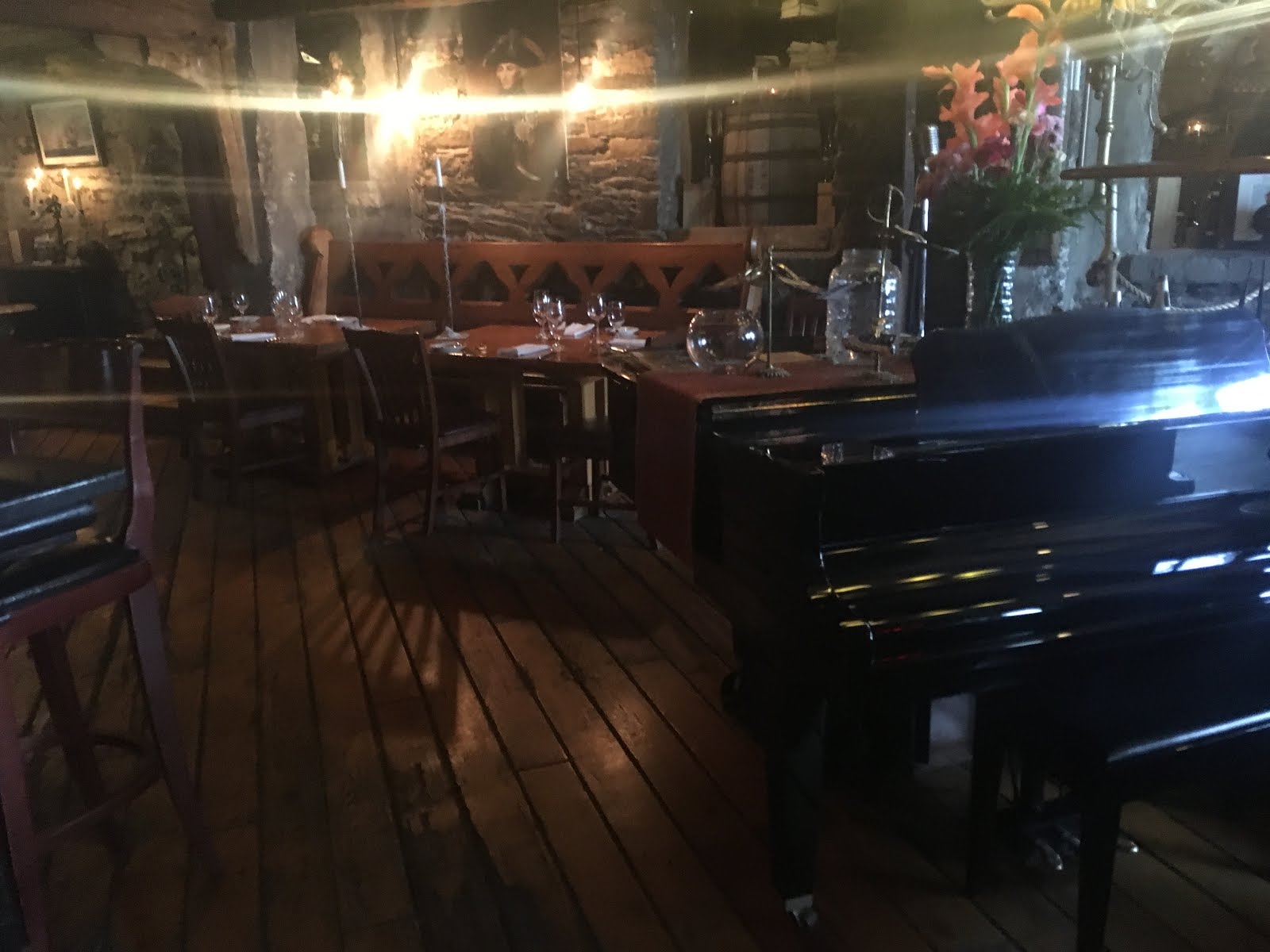
This one was a surprise. It was far and away the most expensive burger on the list, at $25 -- I figured that such a price was a consequence of sourcing a limited amount of an exotic meat. However, I'd never been inside The Press Gang before. As the side picture demonstrates, it's a candlelit wine cellar with a grand piano.
This city is always full of surprises. And sometimes, they're $25 surprises.
Anyway, back to the burger. This one was... impeccable. As you can see from the photo, the burger was neat and tidy. Well-packed. It smelled of sharp wine and soft herbs.
The sauce was thick and finely minced, more of a pesto than a spread. It had just a little kick to it, similar to a smattering of horseradish. It paired wonderfully with the smooth buttery cheese. The onions were fully caramelised. Not just "fried until soggy and brown", but steadily and slowly cooked until they were softer than the brie.
All the toppings were homogenous and smoothly distributed - I believe this is because the meat patty was very thick, and dense. Chunkier toppings would have bounced right off of it.
Similarly, the bun was also very heavy and dense. Once again, it makes sense. Pressed against that burger and soaked with sauce, a lighter bun would have been torn apart in my hands just by holding it.
The meat was delicious, but distinctively dark and lean. I suppose there aren't a lot of kangaroos out there with marbled layers of fat, eh?
The only downside to the considerable densities of each ingredient was that it resulted in the bun pushing the burger out, meaning the last four bites were bread-only. (But very good bread.)
In the Burgerdome:
As a fighter, this burger plays a defensive game. It’s not the hunter, but the hunted - he’s the bunker sniper, the guy who learned to get his defences up, let the enemy take their hopeless shot, and then retaliate. Preferably at long range, with a rifle. That helps him to choose the battlefield, and keep him in control of the conflict. But even if someone does close the distance, he's prepared. No matter the attack, he's got something to help him survive it. He doesn't go anywhere without scrap steel armour plating underneath the leather. It might get messy at that point, though, which he considers distasteful. His game plan is to be the one that hits last, and he prefers it if that last hit is as neat as possible.
2. Brewster’s "Seoul Burger" (chosen by L.H.)
House-made beef patty glazed with Korean Bulgogi BBQ sauce, topped with seared pork belly, gochujang ketchup, pickled daikon and red cabbage and kimchi mayo.

The initial aroma was promising - spicy, and just a bit sour. With the first bite, though, I was confused. Still a lovely aroma, but only a very little of that transferred into the taste.
At first.
As I kept eating, I got to the section that was better mixed with the sauce. That's when the synergy really started to kick in. The burger got better and better with each bite, the sauce complementing the bun, the other toppings, and the meat.
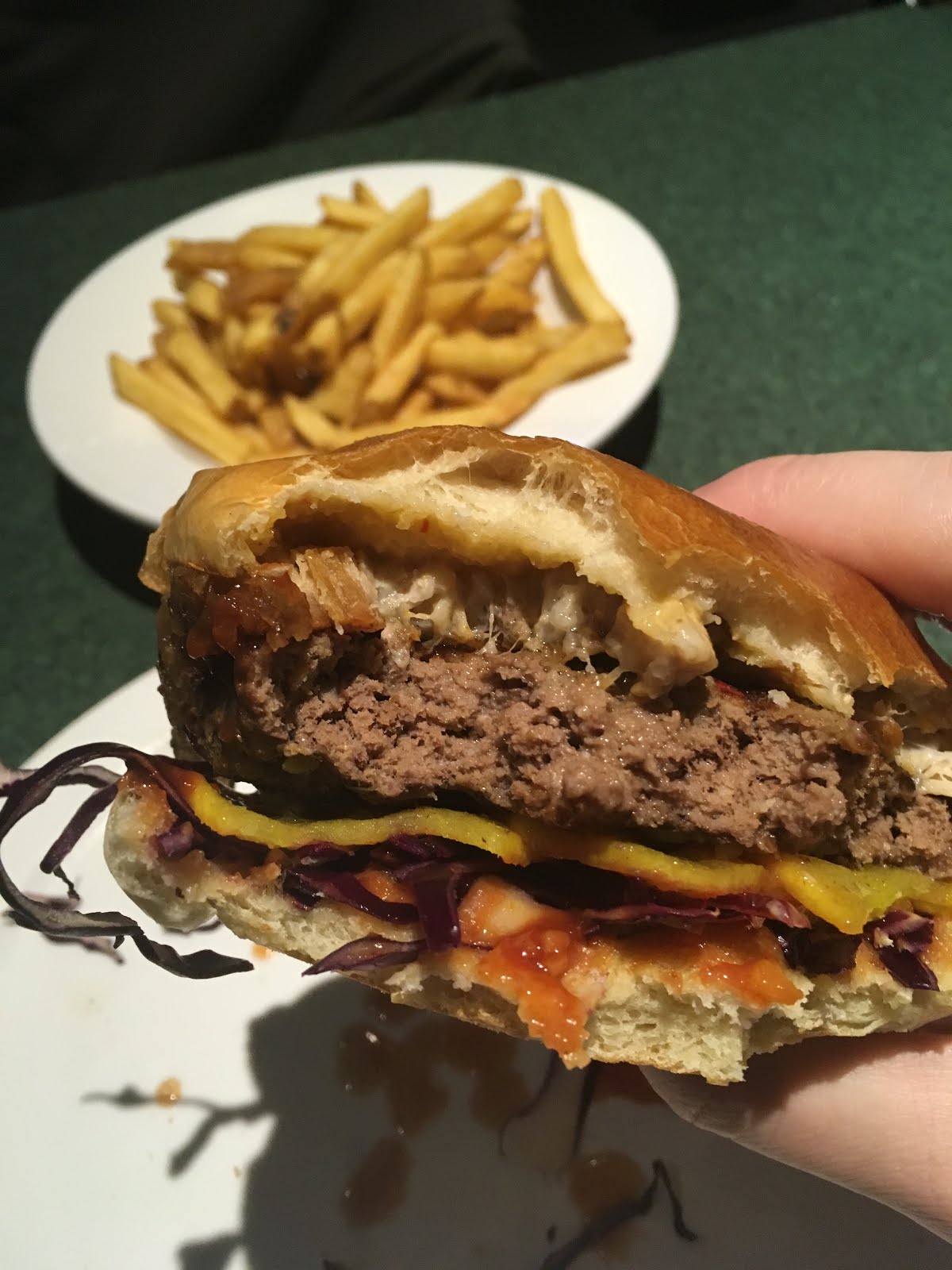 The kimchi mayo and bulgogi barbecue sauce combined into something special, but the real surprise was the pickled daikon. It had a nice chewy crunch, a stronger texture with a pleasant (if subtle) taste. I'd seriously consider using them instead of pickles in future burgers.
Aside from the slow start, the only other drawback was the seared pork belly - I could barely notice it.
In the Burgerdome:
This burger is unassuming at first, and then spicy. She’s not a bomber -- that's too chaotic and quick. Instead, she’s a trapper. A minelayer. She’s keeping her edge in the arms race by turning the land around her into a deathtrap only she can navigate. On supply runs, she mines a choke point and waits for payday. This isn’t merely an “evil genius” at work — these plans take effort and resources. You might wonder: How did she get so much gunpowder to begin with? Rumour is, she was one of the arms dealers that helped ignite the war in the first place.
In the saga of these eight characters who survived the apocalypse, this woman is the arch-villain of the story. She's the true threat - the one who holds the power, and can't be taken down easily. She's capitalizing on the anarchy in the world, and turning it into a type of fear and chaos she can use to gain more power.
But maybe somebody can stop her...
1. Lot Six’s "Six Meat Under" (chosen by M.A.)
6-oz patty, bacon jam, smoked gouda, onion crisps, lettuce, tomato and Sriracha aioli, served with frites.

There's a subtle sweetness from the bacon jam, and a little spice from the Sriracha that was kept under control by the aioli (garlic mayonnaise). This was a pleasant surprise, since both bacon jam and Sriracha are a bit overplayed due to their current trendiness. Instead, there was a balance of flavours in this burger, where neither sweetness nor spice took over, but both contributed to the mix.
The same thing goes for the vegetable assortment. It's a little surprising that none of the other burgers had lettuce and tomato -- but it's more surprising how much I appreciated their presence here.

Nothing here overpowers the sizeable patty, it's allowed to succeed on its own strengths, juicy and well-cooked.
Finally, the toasted sesame seed bun absorbed all the relevant juices, and helped shape the texture of the burger to make sure that with every bite, the full complement of flavours was delivered.
In the Burgerdome:
This burger has a bit of everything. Points in every skill, knowledge of old techniques, and equipped with new tech. How does this fit into a post-apocalyptic world? It's part of the secret organization known as “Lot Six”, that’s still holding on to all the tools and technologies of the old civilization. Their orders are to save the world, but they know that opening their doors to share all the advances they've saved will only benefit the warlord with the biggest army.
So they hide. They watch. They train. And they send their agents out into the wasteland, to keep people alive, to help them find their way back to civilization, and to keep the warlords in check.
He looks like just another drifter, so no one looks too closely. But if they did, they might notice that the buckles strapping his patches of leather together are decorative. The rust on his machete is paint. His pocket knife doesn’t get jammed when he opens it. His watch tells the time. Everything works.
That’s because this man is on a mission, and once he gets to the Western Capital, he’s got all the skills he needs to complete his objective in any way he chooses, and then disappear before the sun comes up. But first, this outpost he's found in the wastes is having a problem with a local baroness, who's turning the area into a minefield.
Not on his watch. He gathers the other wanderers around the fire, and pulls out an old scroll of paper. If we work together, we can make this land safe, he tells them.
He's got a plan.